


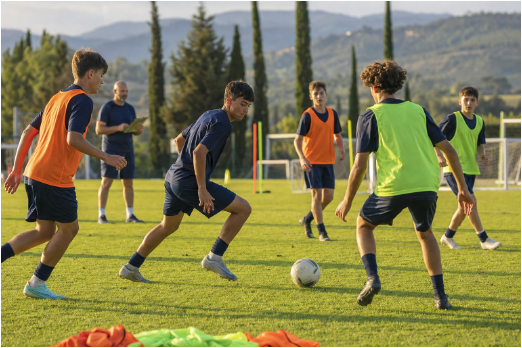
A football academy in Italy is a structured youth training environment — the youth section of a professional club, a federally recognised grassroots school, or a private programme — where sessions follow a written plan with defined objectives, progressive workload and some form of assessment. The distinguishing feature is not the facility, nor the badge on the tracksuit. It is whether the week has a logic, and whether that logic shows up on match day.
In brief: structured training means planned progression, objectives stated in football language, and a way of checking whether a behaviour holds under pressure. Before committing, ask for three things: the written weekly plan, the assessment method, and the name of the person responsible for safeguarding. Documents, not descriptions.
Most of what families read about training experiences in Italy describes places rather than methods: pitch counts, dormitories, trial dates, tournament calendars. Useful practical information, but it says nothing about how a fifteen-year-old actually gets better at scanning before receiving, or at defending a transition when the game is stretched. This piece looks at the process instead — how a week is usually planned, why modified games do so much of the teaching, how feedback is delivered, and what to ask before signing anything.
Structured training: what it means, and what it is not
Structured training means three things working together. First, a planned progression: each block of weeks has a theme, and each session inside that block contributes to it. Second, explicit objectives, stated in language the players can repeat back — when we press, what triggers it, where the free player usually appears. Third, some form of measurable outcome, even a simple one: can the player produce the behaviour under pressure, repeatedly, against opponents who resist?
What it is not: a large quantity of well-organised drills. A session can look excellent — cones aligned, high tempo, nobody standing still — and transfer very little to Sunday. Unopposed passing patterns build rhythm and confidence, and they have a place. But a pass made without an opponent, without a defensive cue, without a clock running in the player’s head, is not quite the same skill the match will ask for.
In the teenage years this gap is the one coaches tend to talk about most. Players are growing quickly and often unevenly; technical habits settle in; training starts to interact with school, travel and competition in ways nobody planned in September. A structured environment is, in practice, the mechanism that keeps growth, learning and fatigue inside the same conversation instead of three separate ones.
Game intelligence first, technique inside the game
Italian football is frequently reduced to a caricature about defending. A more useful way to describe what many Italian programmes emphasise is tactical education: teaching roles, principles of play and collective organisation from an early stage, so that individual technique is learned as a tool for solving a game problem rather than as an isolated craft. That is a description of emphasis, not a national law — coaching quality varies inside Italy as it does anywhere — but it is a reasonable lens for reading a session plan.
In practice, the technical objective usually sits inside a context. First touch is rarely trained as a touch; it is trained as a touch oriented away from a pressing opponent, toward the space the team wants to attack. Passing is trained as a decision about timing and weight, given what the receiver can see. Finishing is trained with a defender arriving late and a goalkeeper set — because that, rather than a static shooting line, is the situation the player will meet.
Youth development in Europe is also studied as a comparable process rather than treated as a national secret. A 2014 research project funded by UEFA gathered new data from 41 leading youth-development experts across seven countries, Italy included, with the stated purpose of identifying good-practice principles for player development and coaching along the performance pathway. Programmes that can describe their own principles in that kind of language — clearly, consistently, on paper — are usually easier to evaluate than those that talk mainly about results.
From plan to pitch: the weekly microcycle
The microcycle is the planning unit that turns intentions into training: a week organised around the match, shaped by distance from the last game, distance to the next, and what the body and the brain can absorb in between.
There is no single mandated template, and the shape described here should be read as common coaching practice rather than as a rule with evidence attached. Many staffs work from a simple sequence. Days close to a match often carry less mechanical load and more cognitive work — possession structures, positional games, video-led detail, recovery for those who played. Somewhere in the middle of the week, a heavier session typically sits, with larger spaces and more duels. As the match approaches, volume usually drops and the emphasis moves toward speed, clarity and confidence rather than new information. Individual academies adapt this to their competition calendar, age group and pitch availability, and they should be able to explain why their version looks the way it does.
Objectives inside the week work best when they are concrete and few. Pressing triggers. Build-up patterns against a specific shape. Behaviour in the first five seconds after losing the ball. Defensive set-piece roles. Two or three themes per block, revisited with variation, tend to travel further than a new idea every session.
Families comparing a two-week summer stay with a three-month block are really asking the same question: how does the time on the ground fit into an actual training week? Any programme presenting itself as a football academy in Italy should be able to map a stay onto that weekly rhythm — training days, match days, recovery, review — rather than onto a sequence of isolated showcase sessions. The distinction matters for assessment as much as for learning. A visiting player’s first week in a new environment is rarely representative of their level. The third often is.
The calendar complicates everything. School hours, long commutes, tournaments that compress three matches into two days. Structured does not mean rigid; a good plan is written so that it can be cut down, with a clear rule about what goes first when the week collapses. Usually that is volume, not quality.
Game-based learning: small-sided games and constraints
Modified games are among the most widely used teaching tools in youth coaching: the real game, reduced in size and altered in its rules. The rationale coaches give is straightforward. In a smaller space with fewer players, each player spends more of the session near the ball, and the actions stay attached to real cues — an opponent, a direction, a scoreline, a clock.
Rules are the coaching. Limit touches and players have to look earlier. Add a scoring zone and the team learns to attack a specific area. Play 4v3 and the group practises exploiting an overload; play 3v4 and it practises surviving one. Rule design is also studied formally: a 2017 paper in Biology of Sport examined rule modification in small-sided games as a way of inducing higher physiological responses in young players, which gives a sense of how deliberately these variables are manipulated. Separately, and as a matter of coaching practice rather than research, it is fair to expect a coach to be able to say why a constraint was changed — whether the intention was technical, tactical or physical.
One widely used practice format is the 3v3 plus one, built around a neutral player and designed to develop a unit’s ability to build and progress play; the exercise simulates an attacking phase in which a team is arranged in a diamond shape to play through the opposition. The neutral player is not decoration. It creates the numerical superiority a build-up phase depends on, and it forces the defending unit to decide who presses and who covers.
The thread running through this family of exercises is representativeness: keeping space, time, opponents and consequence close to what the match will contain, so the distance between a player who trains well and a player who plays well gets shorter.
Position-specific work without early specialisation traps
By mid-adolescence, position-specific coaching becomes genuinely valuable. Centre-backs need defending of the space behind, timing of the step forward, and composure in the first phase of build-up. Full-backs live between the touchline and the inside channel. Midfielders work on body orientation before receiving, the half-turn, and the choice between breaking a line and circulating. Forwards train movement in relation to the last defender’s shoulder, and finishing under fatigue. Goalkeepers need distribution under pressure treated as a football skill, not an appendix.
The trap is labelling a thirteen-year-old permanently. Bodies change, and so do the qualities that define a role. Many programmes therefore rotate players through adjacent positions for a period, on the reasoning that universal competencies — scanning frequency, body shape on receiving, first touch under pressure, defending one against one — transfer everywhere, while a fixed role learned too early can limit adaptability later.
This approach may also help late developers. A player who is behind physically can be ahead in understanding, and an environment that assesses decision-making and technique under pressure, rather than duels won alone, is more likely to keep that player in the pathway long enough for biology to catch up.
Physical preparation built into football actions
Physical work in youth football is preparation for performance, not aesthetics. The usual priorities are strength as a basis for control and resilience, acceleration and deceleration mechanics, change of direction, and mobility — in doses appropriate to age and training history, progressed one variable at a time.
Much of it can live inside the ball work. Repeated sprint demands appear naturally in transition games; deceleration is trained every time a player defends a one-against-one honestly. What cannot be improvised is the accounting. A teenager may combine club training, school football, private sessions and weekend tournaments without anyone adding up the weekly total. In a structured programme, someone is explicitly responsible for doing exactly that, in writing, with the authority to reduce it.
Recovery belongs in the plan as well, and at academy level it is mostly unglamorous: consistent sleep, eating enough around sessions, hydration, and a simple weekly check on perceived fatigue and soreness. A one-to-ten rating collected honestly and actually read is often more useful than technology nobody reviews.
Feedback loops: video, benchmarks and individual plans
Feedback is where structure either becomes development or evaporates. The common failure is volume: a fifteen-minute montage of everything a player did wrong, delivered once a month, tends to change very little. Many coaches work the other way round — one or two target behaviours per block, named in the same words every time, reinforced during sessions rather than only in a meeting room.
With young players, a common approach is to keep clips short: three or four sequences tied to a principle already being trained. Before receiving, where were your eyes. When the ball travelled to the far side, where were your feet pointing. When we lost it here, what was your first step. The clip makes an abstract instruction visible.
Benchmarks should reflect the game. Technical execution under pressure. Repeatability across a full match rather than a bright ten minutes. Speed of decision, not only speed of legs. And progress in the specific behaviours written into an individual development plan — a short document with two or three goals, the training focus attached to each, a review date and a named coach responsible. Written, reviewed, shared with the player. Otherwise it is a file, not a plan.
The Italian framework: categories, recognition and safeguarding
Italy’s youth game sits inside a defined federal structure, which is useful context when comparing programmes. The FIGC’s youth and school sector publishes annual regulations for grassroots activity, setting out match formats and categories by age band. In the framework issued for the 2026/27 season, the youngest category, Piccoli Amici, is defined as children born from 1 January 2020 who have turned five, with Primi Calci and Pulcini defined by their own year-of-birth windows.
Clubs can also be formally recognised at different levels. In the recognition framework published for the 2020/21 season, the categories listed were Centro Calcistico di Base, Scuola di Calcio and Scuola di Calcio di Élite, each with its own requirements and application deadlines — including presentation forms to be filed by set dates and an online youth-sector census to complete. Recognition is not a guarantee of coaching quality, but it is a verifiable signal that a club has met federal criteria rather than simply asserting a standard.
In practice, proof of recognition is a document, not a claim on a website. A club should be able to show its federal affiliation and the recognition granted for the current season, and to say which regional youth-sector coordination office issued it; recognition is renewed season by season, so a certificate from three years ago tells you little. Families can cross-check by asking for the season in question, the category granted, and the name of the technical official responsible — then verifying that the same details appear in the regional federation’s published communications. For a private programme that is not itself a recognised club, the equivalent question is which affiliated club or facility it works with, and under what agreement.
Safeguarding is an explicit obligation. The official communication opening the 2026/27 season restates that the federation and its components comply with Italian Legislative Decrees 36/2021 and 39/2021 and with provisions issued by CONI, UEFA and FIFA on preventing and countering abuse, violence and discrimination. At club level this often takes the form of a published safeguarding policy aligned with FIGC guidelines and accompanied by a code of conduct — Juventus, for example, presents its safeguarding policy as the club’s organisational and control model for sports activities. Any programme hosting minors should be able to show something equivalent, including how a concern is reported and to whom.
Facilities are not methodology
European clubs have spent heavily on infrastructure over the past decade. A Europe-wide review of training sites covers 950 facilities used by 673 clubs; top-division clubs invested more than €1 billion in training facilities over a five-year period, and 53 top-tier clubs across 33 countries opened new training centres within two years, with at least 27 more in development. The total estimated annual youth development budget of European top-division clubs stood at €870m in 2020.
Those figures describe capacity, not learning. A hybrid pitch does not teach scanning. When visiting an academy, the facilities are worth ten minutes of attention; the session is worth two hours.
A practical checklist before you commit
- Ask to see a written weekly plan. Not a marketing timetable — an actual microcycle with objectives per session. If nobody can produce one, structure is being claimed rather than practised.
- Ask what the current block’s theme is. Inside a structured programme, a coach answers in one sentence. Often the players can too.
- Check coach-to-player ratios and qualifications, including who is responsible for physical preparation and who is responsible for safeguarding.
- Ask how players are assessed: which behaviours, how often, written or verbal, shared with the family or not.
- Watch a full session. Look for opposition in most exercises, coaching that stops play briefly and rarely, and intensity that stays high without becoming reckless.
- Clarify the format honestly. A one-week camp and a three-month development block are different products with different purposes; be cautious with anyone who blurs them.
- Ask about the unglamorous details: insurance, medical certification, supervision of minors outside training hours, school arrangements, and what happens if a player is injured in week two.
The warning signs are equally simple. Guaranteed trials. Talk of contracts. Reluctance to let a family observe a normal session. Vague answers about who is accountable for a minor when the training day ends.
Questions families ask most often
What is a football academy in Italy, exactly?
It is a youth training environment based in Italy that organises sessions around a plan rather than around isolated drills. It may be the youth section of a professional club, a federally recognised grassroots school, or a private programme. The label itself is not regulated in the way federal recognition categories are, so the methodology matters more than the name.
At what age can a child start?
Organised grassroots football in Italy starts very young. Under the FIGC youth sector regulations published for the 2026/27 season, the Piccoli Amici category covers children born from 1 January 2020 who have turned five, with older bands defined by year of birth. Selective or performance-oriented programmes generally begin later; entry ages vary by organisation, so ask directly.
How can I tell whether a programme is properly structured?
Ask for documents rather than descriptions: a weekly plan with session objectives, the theme of the current training block, the assessment method, and the safeguarding contact. Then watch a full session and check whether what happens on the pitch matches what is written on the page. Consistency between the two is the signal worth trusting.
Does federal recognition guarantee quality coaching?
No. Recognition categories such as Centro Calcistico di Base, Scuola di Calcio and Scuola di Calcio di Élite confirm that a club has met defined federal requirements for a given season. That is a verifiable baseline, useful when comparing organisations, but it says nothing about whether a specific coach can teach decision-making to a sixteen-year-old. Both checks are worth making.
Are short camps worth it compared with longer blocks?
They answer different questions. A short camp can expose a player to a different coaching language and a different competitive intensity. A longer block allows a full training rhythm — loading, recovery, review — to be repeated often enough to change habits. Problems arise mainly when the two are marketed as if they were the same thing.
What progress actually looks like
Development in a well-run academy is rarely dramatic week to week. It looks like a midfielder checking her shoulder twice before the ball arrives instead of once. A centre-back stepping half a metre earlier. A winger who used to fade after an hour still making runs in the final ten minutes. Small, repeatable behaviours, trained deliberately, until they hold under fatigue and pressure.
That is the case for method over marketing. Planning gives the work direction, game-based practice keeps it honest, and feedback makes it stick. When a programme can explain all three in plain language — and show the paperwork behind them — a season abroad has a far better chance of producing genuine improvement than an expensive memory.