


The Malta FA’s audited accounts for 2025 highlight a significant improvement in the Association’s financial situation, recording record revenues despite a busy calendar year.
Total revenue for the year reached an impressive €16.3 million, a 26 per cent increase from 2024, while annual expenditure increase to €13.9 million, largely due to a number of events marking the Malta FA’s historic 125th anniversary. As a result, after accounting for finance costs and depreciation, and then adding all grants, the Malta FA recorded a closing balance of almost €1.2 million in income.
Photo courtesy of Malta FA
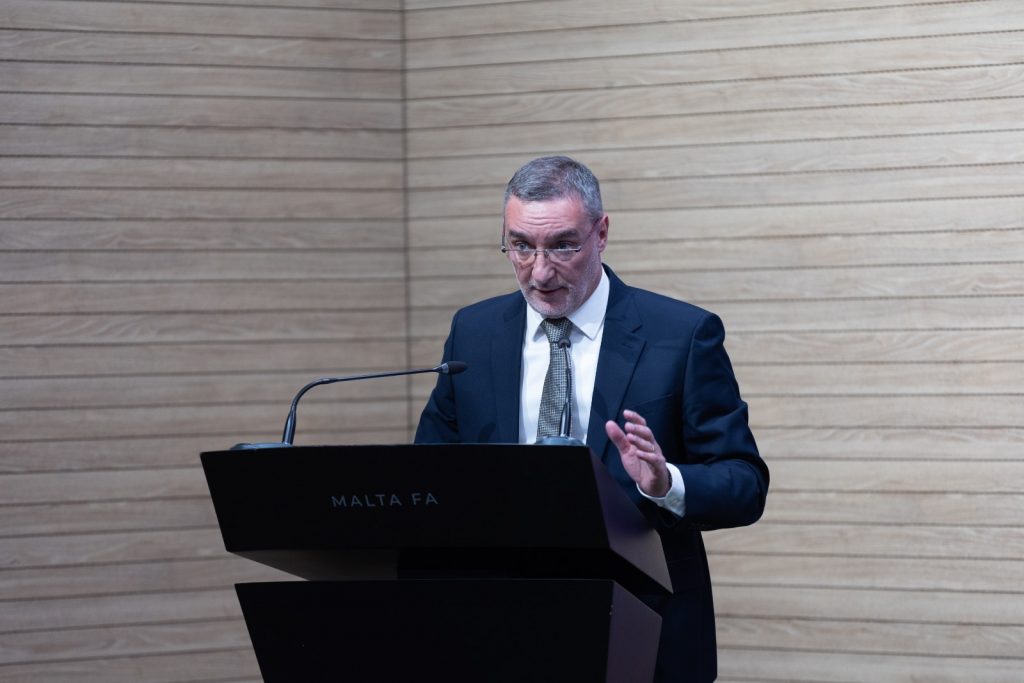
The audited accounts were presented during the Association’s First General Assembly for 2026 at Centenary Hall by Malta FA Treasurer Ivan Mizzi, who delved deeper into the factors contributing to the performance during the 2025 financial year.
RECORD REVENUES
During the 2025 financial year, the Malta FA recorded €16.3 million in revenue, a substantial increase from that of 2024.
Gate money, for both international and domestic matches, increased by around €680,000, particularly since there were key international fixtures. Gate receipts from domestic matches also increased sharply.
Income generated from television and other rights amounted to just below €3 million, representing 18 per cent of the Association’s total income. Together with the annual grants received through the FIFA Forward (€2.4 million) and UEFA Participation (€1.1 million) programmes, this income represents a key part of the Association’s revenue for the financial year. Throughout the year, Malta continued to host a number of UEFA Youth qualifying and development tournaments, contributing to the income received from these sources.
Additionally, the work of the Association’s marketing department continued to have a positive impact on financials, with €780,000 being generated throughout the year as a result of sponsorships. The Malta FA also recorded a sharp increase of €347,000 in income generated through sports facilities over the previous year, reaching a sum of just over €1 million. Other important income came from the sale of merchandising.
BUSY 2025 CALENDAR
As previously mentioned, the Malta FA had a busy 2025, with a series of activities due to its 125th anniversary, including the Jubilee Cup, as well as a number of UEFA tournaments. This prompted the Malta FA’s total expenditure for 2025 to amount to €13.9 million.
Given Malta’s status as the largest sports association in Malta, with the equivalent of 117 full-time employees (administrative and technical), the Malta FA’s annual wage spend for 2025 amounted to €3.7 million, representing 26.7 per cent of total expenditure. This wage spend, in percentages, is lower than the average wage spend for National Associations in Europe. Despite the hectic calendar, the Association’s wage bill for 2025 was reduced by €30,000 from 2024.
The player appearances, allowances and bonuses that were granted to the respective men and women national teams amounted to €622,000. The total travel and accommodation cost amounted to €2.6 million, with the largest portion of this expenditure being due to the Men’s National ‘A’ Team (€762,684), spread over 10 matches. The rest of the expenditure is spread out across the rest of the National Teams, including the Women’s National Teams, the Futsal National Team, as well as the Beach Soccer National Team. It is important to note that during 2025, there were a total of 102 international matches organised, an increase from previous years that brought with it further travel and accommodation costs. However, this expenditure prompted a positive impact in income when it comes to grassroots teams.
INVESTMENT IN MEMBERS AND FACILITIES
Over the course of the year, the Malta FA had a number of subsidies, schemes and assistance provided to member clubs and associations, also including referees’ fees and the lease of pitches for domestic competitions. The Malta FA assists all leagues from the Premier League way down to the National Amateur League and also including to all member associations with important financial assistance (subsidies) against the organisation of domestic competitions. This reached a total of €2.1 million.
In addition to this, the Malta FA also spent €920,148 in maintenance and greenkeeping, with the most significant expenditure in this regard being due to the upkeep and maintenance of the Ta’ Qali Sports Complex, reaching €683,148. This covers the National Stadium, the Centenary Stadium, and the Training Grounds. It is important to note that during 2025, the National Football Centre was officially inaugurated, with the Association’s technical sector staff and football members already enjoying the state-of-the-art facilities. During the year, there were over 600 matches played across the two stadia at the Ta’ Qali Sports Complex, the majority of which are matches from domestic competitions that clubs benefit from.
Additionally, the Malta FA also recorded an expenditure of €283,914 when it comes to the Referees Convention, associated with the training and courses for referees. During the year, the Malta FA also provided training to referees for the implementation of the Football Video Support system.
FINANCIAL TARGETS REACHED
The 2025 financial report confirms that despite the financial challenges it experienced during the post-COVID-19 pandemic period (2020-2023), the Association implemented a robust strategy, while also retaining its obligations to member clubs and member associations.
“It is important to note that the plan that was constructed two years ago, with the approval of the Executive Board, is being actuated, and as was presented today, the targets for the 2024 and 2025 financial years have been reached,” Mr Mizzi remarked.
In fact, the €1.2 million surplus recorded throughout the year has gone a long way towards reducing the accumulated deficit of €4.4 million.
“While the Association is maintaining its plans to reduce the accumulated deficit, the Financial Department prepared a cash flow budget until 2028 so that it can have enough liquidity to operate and to be of support to its clubs and members,” Mr Mizzi continued.
“These results are the result of serious and long-term planning, as well as collective work, without removing any of the investment towards all levels of the football pyramid,” he concluded.