
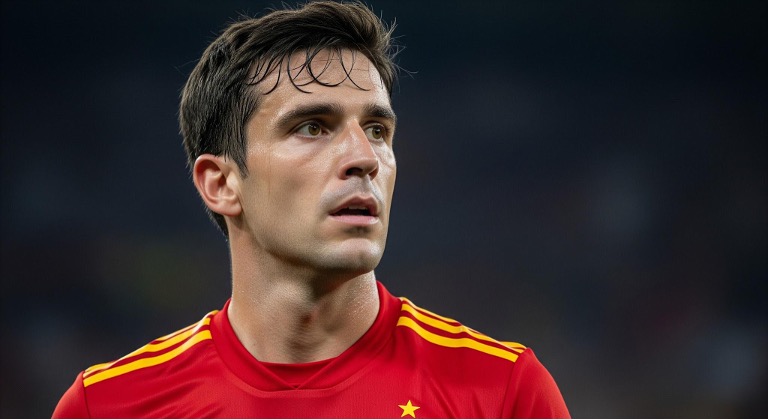
Spain’s 2026 story no longer needs to be framed as a team preparing for the World Cup. La Roja finished the tournament as champions, beating Argentina 1-0 after extra time in the final on 19 July. Ferran Torres scored the decisive goal in the 106th minute, completing a run that took Spain from an awkward 0-0 opening draw with Cabo Verde to a second world title. The route was demanding: wins over Saudi Arabia and Uruguay in the group stage were followed by knockout victories against Austria, Portugal, Belgium and France before the final. What looked in June like a test of a young generation became proof that Luis de la Fuente had built a side capable of controlling different types of matches, not only dominating possession.
De la Fuente’s Continuity Became Spain’s Competitive Advantage
The foundations remained familiar throughout the tournament: possession used to control territory, aggressive counter-pressing after turnovers, technically secure midfielders and wide players capable of stretching compact defences. The important change was not a tactical revolution but greater adaptability. Rodri provided structure and leadership, while Pedri, Fabián Ruiz and the other midfield options gave Spain different ways to progress the ball. Lamine Yamal and Nico Williams supplied width and one-versus-one threat, while Pau Cubarsí’s emergence reinforced a defence comfortable defending high up the pitch. Spain could play patiently, accelerate through the wings or protect a narrow lead without abandoning its identity.
The Cabo Verde Draw Now Looks Like an Early Warning, Not a Crisis
That opening draw is now useful because it shows how quickly tournament narratives can become outdated. Spain had 75 percent possession and 27 attempts against Cabo Verde but could not score. By the end of the competition, the same team had learned how to turn territorial control into results across seven more matches. For readers following judi bola, that progression is a reminder that pre-match reputation should be separated from current evidence such as confirmed line-ups, player availability, opponent style and recent performance. Spain entered later rounds with stronger proof than a badge or ranking: they had shown they could beat compact opponents, survive knockout pressure and win close games. The early frustration did not disappear from the analysis; it became part of the explanation for why the team improved.
Young Stars Grew Up During the Tournament
The World Cup accelerated a transition that had already begun after Euro 2024. Yamal entered his first World Cup as one of the most watched young players in the game, while Cubarsí developed into an important part of a title-winning defence. At the same time, Spain did not ask its youngest players to carry the entire project. Rodri captained the side, Unai Simón provided security in goal, and experienced options such as Aymeric Laporte, Fabián Ruiz, Mikel Oyarzabal and Ferran Torres gave De la Fuente solutions when matches changed shape. That balance between a new generation and established internationals was one of Spain’s biggest strengths. The final itself underlined the point: the winning goal came from substitute Ferran Torres after Nico Williams helped create the opening.
Possession Survived, but Spain Became More Complete
Spain’s success also showed why reducing their football to “tiki-taka” misses the modern version of the team. Possession remained important, but it was connected to pressing, rest defence and faster attacks once space appeared. Spain conceded only one goal across the entire World Cup, against Belgium in the quarter-final, while keeping clean sheets against Portugal, France and Argentina in the final stages. In the wider second-screen culture, live casino Indonesia represents a separate form of real-time digital entertainment, but its mechanics should not be confused with football analysis. Casino games follow product rules and probability models; football performance is shaped by tactics, fitness, match state and opposition. Modern viewers may move between live statistics, replays and social media during a match, yet Spain’s title run rewarded those who looked beyond possession percentages and followed how the team controlled transitions and defended space.
The Knockout Run Changed the Meaning of Spain’s 2026 Campaign
The 0-0 against Cabo Verde initially raised questions about Spain’s ability to break down a deep block. The rest of the tournament answered them. La Roja beat Saudi Arabia 4-0, Uruguay 1-0 and Austria 3-0 before navigating increasingly difficult knockout matches: Portugal 1-0, Belgium 2-1 and France 2-0. Against Argentina, patience was required again, but Spain kept control until Ferran Torres found the winner in extra time. In casino entertainment, Plinko slot is based on random outcomes and a defined game model; Spain’s progression was the opposite kind of process. Their results came from repeated tactical behaviours: controlling central areas, recovering the ball quickly, using width and trusting the squad when substitutions were needed. The final transformed the tournament from a promising regeneration story into a completed championship cycle.
What Comes Next for the New World Champions?
Spain now move beyond the World Cup with a different type of pressure. The question is no longer whether this generation can win the biggest tournament; it is whether La Roja can sustain the standards that produced a second world title. De la Fuente has a core young enough to remain competitive for years, but international football changes quickly. Opponents will study Spain’s pressing triggers, the spaces around their advanced full-backs and the ways they isolate Yamal and Williams. Squad competition will also intensify as another wave of players emerges from Spanish clubs and youth teams. For supporters in Indonesia and across Southeast Asia, the attraction remains obvious: many of Spain’s leading players are already familiar through Europe’s biggest leagues and clubs, while the national team now combines that star power with a clear collective identity. Spain’s 2026 campaign began with questions after Cabo Verde and ended with the trophy in New Jersey. That journey is the clearest evidence that regeneration is no longer the story around La Roja. The story is how a regenerated team became the standard everyone else must chase.