
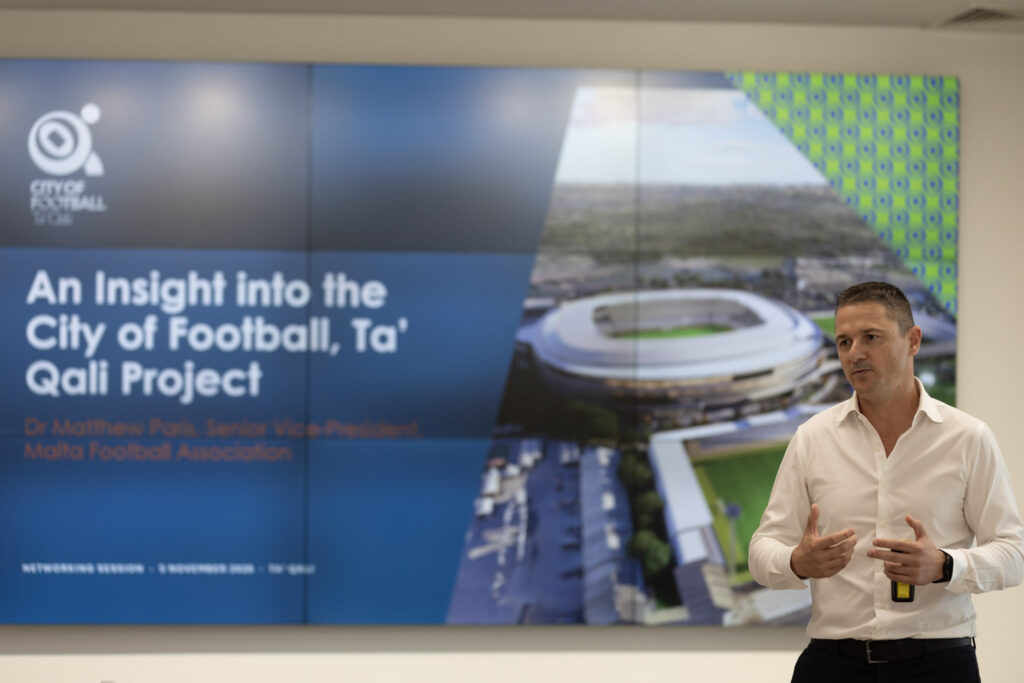
The Malta Football Association hosted a networking session for all of the project’s outside consultants to discuss the way forward for the City of Football project, an ambitious long-term development that will comprehensively regenerate and modernise the Association’s facilities at Ta’ Qali.
Approved during the Malta FA’s General Assembly in April, the City of Football project sets out a structured approach to a large-scale infrastructural investment that will transform the Association’s existing footprint into a fully integrated sporting, commercial and community hub.
Photo courtesy of Malta FA
The project encompasses the partial reconstruction and modernisation of the National Stadium and its surrounding areas, the expansion and upgrading of the Centenary Stadium, as well as the construction of a new compact stadium dedicated to youth football, catering for both boys’ and girls’ categories.
The session was led by Malta FA Senior Vice President Dr Matthew Paris, together with Malta FA Director Business Development Stephen Azzopardi. Attendees included representatives from architectural firm AP Valletta, assurance, tax and consulting firm RSM Malta, design and project management firm Innovative Architectural Structures Malta, law firm Ganado Advocates, as well as representatives from the Ministry for Education and Sport.
The networking session followed an extensive consultation process carried out earlier this year, involving both internal and external stakeholders, aimed at gathering feedback and identifying the needs and expectations that will help shape the project’s development.
The findings, presented during the networking session, highlighted broad support for the proposed regeneration. All internal stakeholders agreed that the redevelopment of the complex is necessary, with only 27% believing that the current facilities adequately meet the Malta FA’s needs. Meanwhile, 86% of external stakeholders expressed the view that the project should serve a purpose beyond football, underlining the importance of creating facilities that can also benefit the wider community.
Participants were also provided with further details about the various components of the City of Football project and the vision underpinning this transformation.
At the heart of the development, the National Stadium will be transformed into a 12,000-seat venue, meeting UEFA Category 4 requirements, while the neighbouring Centenary Stadium will be upgraded from UEFA Category 2 to UEFA Category 3 standards.
The project will also introduce a new 2,000-seat stadium with an artificial playing surface, dedicated to youth football. In addition, an indoor futsal hall will be developed within the refurbished South Stand, while a sports hotel will form part of the new West Stand.
The North Stand will incorporate a new commercial plaza, providing retail, leisure and public amenities, while the existing Millennium Stand will be retained and enhanced as part of the overall regeneration.
Beyond its sporting functions, the revamped National Stadium will also be designed to accommodate major events, including concerts, with the necessary infrastructure to make it a concert-ready venue. Improved road access and connectivity, alongside approximately 300 parking spaces, will further enhance accessibility to the complex.
The wider development will extend beyond the National Stadium complex. The National Football Centre, inaugurated in September 2025, will also incorporate a dedicated beach soccer facility, while the Malta FA Training Grounds will undergo a rationalisation process as part of the Association’s broader infrastructural strategy.
Dr Matthew Paris explained that the project planning is on track and progressing smoothly. He noted that the next milestone will be the submission of the planning permits, followed by the procurement procedure for the selection of the building companies, with the Association targeting the second quarter of 2027.
From his end, Mr Azzopardi highlighted the importance of the Malta FA connecting with consultants during the networking session. “Seeing everyone collaborate and share fresh insights reinforces our commitment to driving innovation and excellence forward. Grateful to be part of such a dedicated team—excited for what we will achieve together next!”
In addition to the presentations, consultants took part in focused workshops covering several key areas of the project, including the architectural concept, project management, legal advisory services and business advisory services. These discussions provided an opportunity to explore the different aspects of the development and contribute expertise towards the next stages of the project.
Through the City of Football initiative, the Malta FA aims to establish a modern, sustainable and multifunctional sporting hub that will strengthen the country’s football infrastructure while creating wider opportunities for the sporting community and the public.