
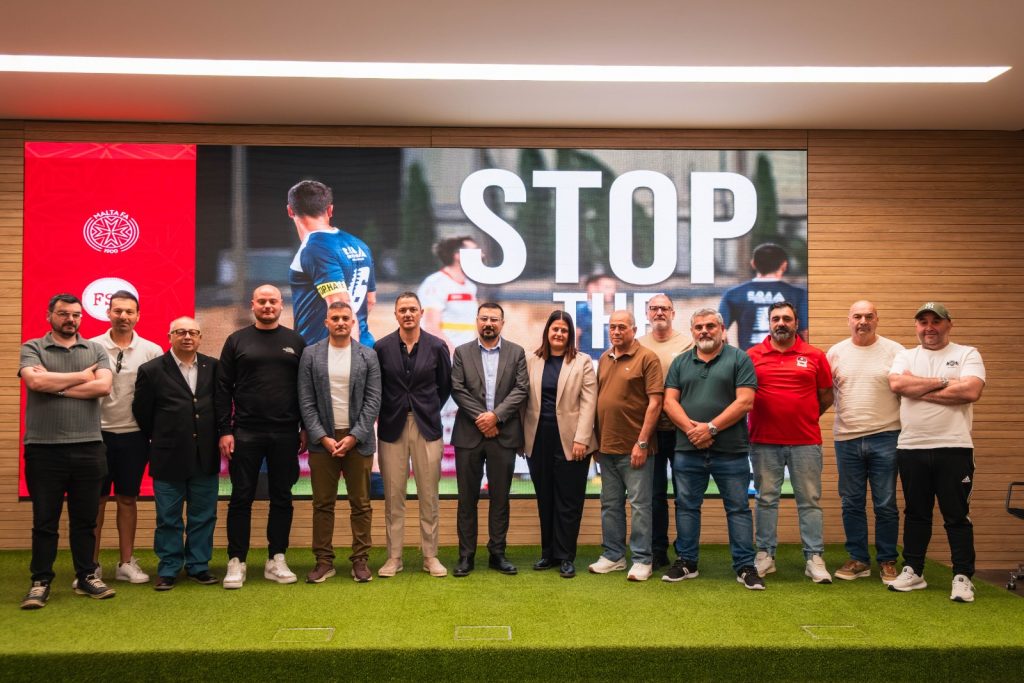
The Malta Football Association’s Football Social Responsibility (FSR) Department held the second edition of the Stop the Hate Convention at Centenary Hall in Ta’ Qali on Saturday, with 68 clubs receiving €1,000 each in recognition of their season-long collaboration with the Malta FA and the Victim Support Agency.
The convention was the most visible part of the campaign, but it sat inside a much wider framework of responsibility-driven work that runs through Maltese football and the public spaces around it. From perimeter advertising at the Centenary Stadium to the 116 006 national victim support line, the season has carried a deliberate message: matchday is a public space, and the bodies that govern it have responsibilities beyond the result on the pitch.
What Stop the Hate Set Out To Do
The campaign launched at the start of the 2025/26 season under an agreement between the Malta FA and the Victim Support Agency. Throughout the season, captains in MFA-organised competitions wore armbands carrying the Stop the Hate message. Centenary Stadium ran perimeter advertising that promoted the campaign and the 116 006 line. Sixty-eight clubs benefited from the funding allocation distributed at the convention.
In his address, Malta FA Senior Vice President Dr Matthew Paris described the convention as “the culmination of season-long initiatives tackling a very real social problem: hate speech.” VSA Chief Executive Officer Brian Farrugia added that “hate-related language and gestures, whether on the pitch, in dressing rooms, in the stands, or online, definitely cause pain and long-lasting traumatic effects on individuals and communities.”
The FSR Department’s Wider Remit
The Stop the Hate work is one strand of the MFA’s broader social responsibility programme, which is itself aligned with the UEFA HatTrick programme, UEFA’s solidarity scheme that channels funding and policy work into national associations. HatTrick has supported Maltese projects on integrity, anti-discrimination, grassroots development and women’s football in earlier cycles, and the FSR Department uses the framework to coordinate its inclusion work across the season.
That coordination matters because hate speech in football is rarely a stand-alone issue. The convention’s panel discussion brought together a Valletta FC player, a Swieqi United Women player, the Vice President of the Malta Sports Journalists Association, and Darren Lewis, President of the Sports Journalists Association of the United Kingdom. The presence of working journalists in that conversation reflects how often the same incidents play out across the stands, the pitch, the dressing room, and the online comments around them.
A Wider Maltese Framework
Football is not the only Maltese sector with a structured responsibility framework around its public-facing audiences. The country’s gambling industry, regulated by the Malta Gaming Authority under the Gaming Act 2018, operates under a separate but comparable set of consumer-protection rules. Operators must implement self-exclusion and self-barring tools, deposit and time limits, and age verification before play begins, with a legal minimum age of 18 across all forms. Penalties for unlawful gambling run from €10,000 to €500,000 per infringement, rising to €1 million and six years’ imprisonment for repeat operator offences.
Beyond the regulator’s enforcement layer, the Responsible Gaming Foundation runs confidential support services, and the national 179 helpline handles gambling-related calls free of charge, twenty-four hours a day. The shape is similar to what the FSR Department has built around hate speech: a regulatory floor, a non-profit support layer, and a free national line. Those penalty bands and helpline numbers are also surfaced on consumer-facing reference pages — online-gambling.com‘s Malta resource sets them out in plain English alongside the MGA’s licensing rules and the 179 number, useful when fans or new players ask what the regulator actually does.
The 179 line is part of a wider Maltese architecture of free helplines that crosses football, gambling, mental health, and victim support, including the 116 006 line that the Stop the Hate campaign promoted at Centenary Stadium throughout the season.
Cooperation Across Bodies
Cross-body cooperation rarely makes headlines but matters here. The Stop the Hate convention drew Minister for Home Affairs, Security and Employment Byron Camilleri into a football setting; the VSA partnership pulled the national victim-support apparatus into the Centenary Stadium. The MGA and the FSR Department do not share a brief, but they share users. Anyone who follows the Maltese game closely is also a citizen and a consumer, and increasingly a registered user of regulated digital services that operate alongside the matchday economy.
That overlap is why the responsibility frameworks do not stay in their lanes. Awareness campaigns share helpline numbers. Stadium perimeter advertising rotates between commercial sponsors and public messages. Captains’ armbands carry social-policy messages while shirt fronts carry sponsor logos. The result is a layered system rather than a siloed one, and the convention was the visible reminder of how those layers interact.
What Comes Next
The 2025/26 Stop the Hate campaign now closes with the convention behind it. Dr Paris suggested the second edition will not be the last, and the inclusion programmes under UEFA HatTrick run on multi-season cycles. The 68 clubs that received €1,000 each will carry the materials into next season’s matchday, and the perimeter advertising will rotate again at Centenary Stadium when the new fixture list arrives.
The real test of the framework will come the next time something goes wrong — a serious incident in the stands, a regulator decision, a public-funding squeeze. For now, the Stop the Hate convention has shown that the architecture is in place, and that the bodies running it are willing to be in the same room.